
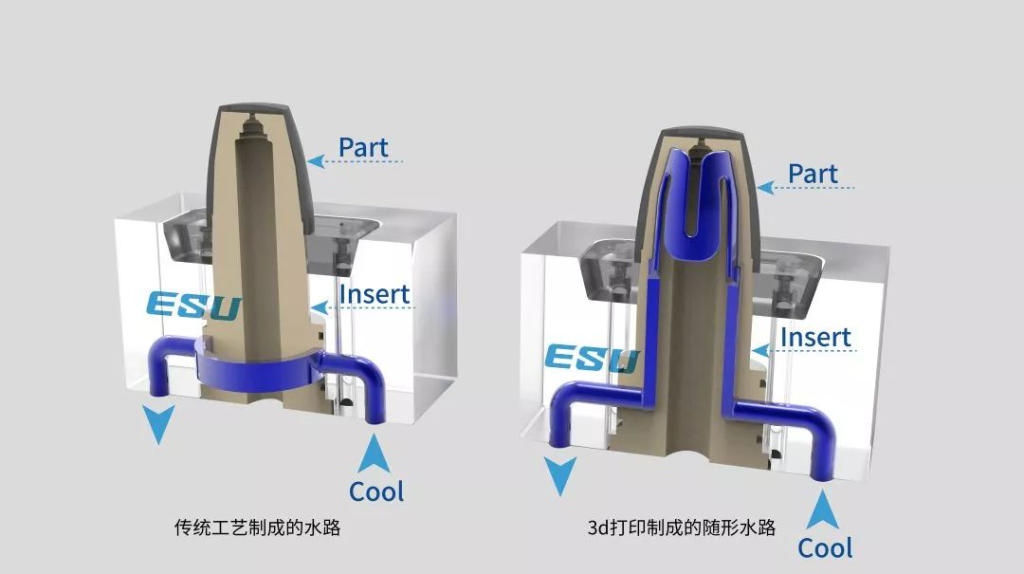
In the competitive landscape of precision injection molding, the bottleneck for cycle time and part quality has always been thermal management. Traditional straight-drilled cooling lines often fail to reach the deep recesses of complex geometries, leading to uneven cooling, internal stress, and the dreaded warping.
The Engineering Edge: Beyond Linear Channels
Traditional cooling is limited by the geometry of the drill bit. Conformal cooling, however, leverages metal 3D printing (DMLS) to create intricate, curved cooling internal channels that follow the exact contour of the part. This ensures a uniform temperature gradient across the entire surface of the mold insert.
Quantifiable Benefits for Your Project:
- Cycle Time Reduction: By bringing the coolant closer to the molding surface, we typically see a 20% to 40% reduction in cooling time.
- Dimensional Stability: Uniform cooling eliminates “hot spots,” drastically reducing sink marks and ensuring tolerances as tight as $\pm 0.01mm$ in high-performance polymers.
- Lower Scrap Rates: Enhanced thermal control minimizes residual stress, which is critical for optical parts or high-pressure housings.
Is It Worth the Investment?
While the initial tooling cost for DMLS-printed inserts is higher, the Total Cost of Ownership (TCO) drops significantly during mass production. For a project with over 100,000 cycles, the saved seconds per shot and the reduction in defect rates offer an ROI that traditional tooling simply cannot match.
At our facility, we integrate advanced thermal simulation with hybrid manufacturing to determine the optimal cooling strategy for your RFQ. Don’t just make a mold; engineer a production solution.